
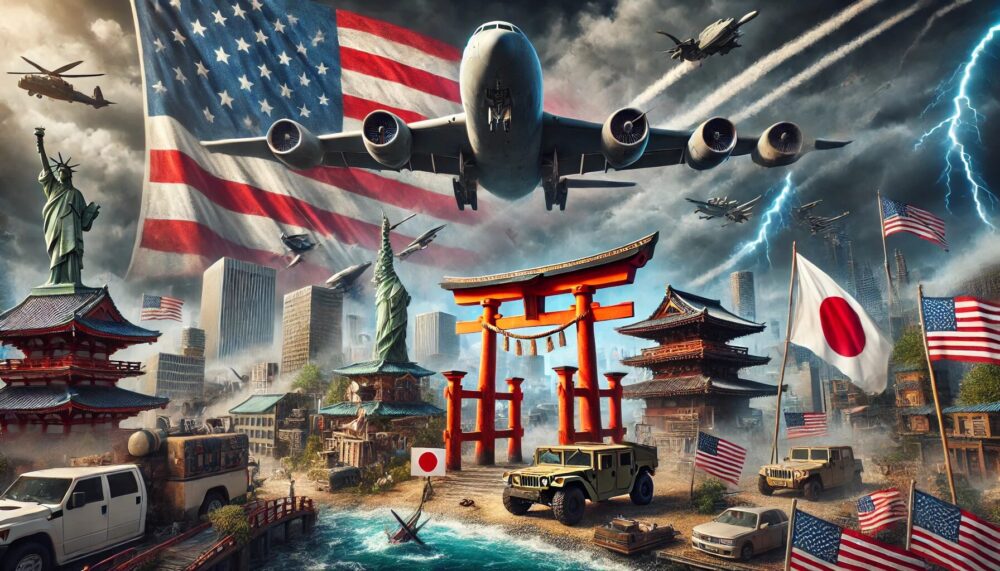
Political analyst Dr. Kan Ito argues that the Japan-U.S. alliance is built upon two structural mechanisms: “dual containment” and “strategic traps.” These concepts help explain why Japan has been unable to exercise fully independent foreign and defense policies since World War II.
Introduction
This analysis examines in detail the essence of the Japan–U.S. alliance as pointed out by Professor Kan Ito. Focusing especially on the two concepts of “double containment” and “entrapment,” it explores the true nature of the Japan–U.S. relationship.
Double Containment Alliance
Definition and Concept
Double containment refers to a “two-layer containment strategy.”
In the context of the Japan–U.S. alliance, it consists of two steps:
First containment: Keep Japan in a permanent state of occupation, preventing it from practicing an independent diplomatic or military policy.
Second containment: Use the contained Japan as a subordinate branch of the U.S. military to contain communist countries such as the Soviet Union and China.
Historical Background
According to Professor Kan Ito, the U.S. government decided as early as 1942 (the year after Pearl Harbor) that postwar Japan would not be allowed to conduct independent foreign or military policies, and steadily implemented that policy.
The True Purpose of the Japan–U.S. Alliance
The purpose of the Japan–U.S. alliance as a double containment alliance is to maintain Japan as a subordinate nation while pursuing America’s strategic interests in Asia.
Entrapment Alliance
Definition and Concept
Entrapment means “to lure into a trap.”
In the Japan–U.S. alliance, entrapment refers to mechanisms that restrict Japan’s freedom of policy-making in exchange for U.S. “protection.”
Concrete Methods of Entrapment
- Substitution of defense responsibility:
“We will protect you, so you don’t need independent defense,” thereby suppressing Japan’s attempts to strengthen its defense capabilities. - Intervention in policy decisions:
Pressure to follow U.S. preferences in military policy, economic policy, historical interpretation, distribution of foreign aid, and more.
Consequences of Entrapment
Japan has lost its ability to conduct an independent foreign or economic policy and is forced into taking actions aligned with U.S. intentions.
Expert Opinions
Remarks by Zbigniew Brzezinski
Zbigniew Brzezinski, former U.S. National Security Advisor, stated the following about Japan’s Self-Defense Forces:
- Japan’s Self-Defense Forces are not the military of an independent nation.
- They are merely an extension tool of U.S. forces in East Asia.
- The U.S. has no intention of giving Japan an independent military capability or autonomous defense ability.
Views of Senior Indian Ministry of External Affairs Officials
According to a senior official (director-level) of the Indian Ministry of External Affairs, with whom Professor Ito interacted after the end of the Cold War:
- A U.S. alliance is not an equal relationship but a subordinate one.
- Any country allied with the U.S. ultimately becomes subordinate to the U.S.
- India rejects a formal alliance with the U.S. because it does not want to be placed in a “miserable situation like Japan.”
Conclusion
According to Professor Kan Ito, the essence of the Japan–U.S. alliance is not the surface-level notions of “mutual defense” or “friendship.” Its true purpose is the containment and subordination of Japan by the United States. The concepts of double containment and entrapment provide essential insight into understanding the true character of this alliance.
Japan must accurately recognize the nature of this alliance and reconsider strategies to protect its national interests and independence.
▼ Other Languages / 他言語版はこちら
🇯🇵 日本語
https://kanoujournal.com/bureaucrats/
🇺🇸 English
https://kanoujournal.com/us-japan-alliance-en/
🇬🇷 Ελληνικά
https://kanoujournal.com/us-japan-alliance-gr/
🇵🇱 Polski
https://kanoujournal.com//us-japan-alliance-pl/
🇹🇼 繁體中文(台湾)
https://kanoujournal.com//us-japan-alliance-zh/
🇻🇳 Tiếng Việt
https://kanoujournal.com//us-japan-alliance-vi/
🇮🇩 Bahasa Indonesia
https://kanoujournal.com//us-japan-alliance-id/
🇫🇷 Français
https://kanoujournal.com//us-japan-alliance-fr/